The gaming industry is big business in the U.S., contributing an estimated US$240 billion to the economy each year, while generating $38 billion in tax revenues and supporting 17 million jobs.
What people may not realize is that slot machines, video poker machines and other electronic gaming devices make up the bulk of all that economic activity. At casinos in Iowa and South Dakota, for example, such devices have contributed up to 89 percent of annual gaming revenue.
Spinning-reel slots in particular are profit juggernauts for most casinos, outperforming table games like blackjack, video poker machines and other forms of gambling.
It is curious how slot games moved from being an after-thought for most casinos to a staple for any gambling platform that wishes to retain relevance in the current market. Now, slot machines make up the highest percentage of played games and, in turn, a significant source of income for casinos. This increased preference for slots is attributed to exciting designs and themes.The allure of slot. If the machine returned $1.80, then the player won $0.30. Fortunately, for the manufacturers and casinos, the ability to say the player, 'Won,' something, and therefore, the ability to offer machines with hit rates occasionally as high as 70%, they are able to play into the players Psychology.
What about slot machines makes them such reliable money makers? In part, it has something to do with casinos’ ability to hide their true price from even the savviest of gamblers.
The price of a slot
An important economic theory holds that when the price of something goes up, demand for it tends to fall.
But that depends on price transparency, which exists for most of the day-to-day purchases we make. That is, other than visits to the doctor’s office and possibly the auto mechanic, we know the price of most products and services before we decide to pay for them.
Slots may be even worse than the doctor’s office, in that most of us will never know the true price of our wagers. Which means the law of supply and demand breaks down.
Casino operators usually think of price in terms of what is known as the average or expected house advantage on each bet placed by players. Basically, it’s the long-term edge that is built into the game. For an individual player, his or her limited interaction with the game will result in a “price” that looks a lot different.
For example, consider a game with a 10 percent house advantage – which is fairly typical. This means that over the long run, the game will return 10 percent of all wagers it accepts to the casino that owns it. So if it accepts $1 million in wagers over 2 million spins, it would be expected to pay out $900,000, resulting in a casino gain of $100,000. Thus from the management’s perspective, the “price” it charges is the 10 percent it expects to collect from gamblers over time.
Individual players, however, will likely define price as the cost of the spin. For example, if a player bets $1, spins the reels and receives no payout, that’ll be the price – not 10 cents.
So who is correct? Both, in a way. While the game has certainly collected $1 from the player, management knows that eventually 90 cents of that will be dispensed to other players.
A player could never know this, however, given he will only be playing for an hour or two, during which he may hope a large payout will make up for his many losses and then some. And at this rate of play it could take years of playing a single slot machine for the casino’s long-term advantage to become evident.
Short-term vs. long-term

This difference in price perspective is rooted in the gap between the short-term view of the players and the long-term view of management. This is one of the lessons I’ve learned in my more than three decades in the gambling industry analyzing the performance of casino games and as a researcher studying them.
Let’s consider George, who just got his paycheck and heads to the casino with $80 to spend over an hour on a Tuesday night. There are basically three outcomes: He loses everything, hits a considerable jackpot and wins big, or makes or loses a little but manages to walk away before the odds turn decidedly against him.
Of course, the first outcome is far more common than the other two – it has to be for the casino to maintain its house advantage. The funds to pay big jackpots come from frequent losers (who get wiped out). Without all these losers, there can be no big winners – which is why so many people play in the first place.
Specifically, the sum of all the individual losses is used to fund the big jackpots. Therefore, to provide enticing jackpots, many players must lose all of their Tuesday night bankroll.
What is less obvious to many is that the long-term experience rarely occurs at the player level. That is, players rarely lose their $80 in a uniform manner (that is, a rate of 10 percent per spin). If this were the typical slot experience, it would be predictably disappointing. But it would make it very easy for a player to identify the price he’s paying.
Raising the price
Ultimately, the casino is selling excitement, which is comprised of hope and variance. Even though a slot may have a modest house advantage from management’s perspective, such as 4 percent, it can and often does win all of George’s Tuesday night bankroll in short order.
This is primarily due to the variance in the slot machine’s pay table – which lists all the winning symbol combinations and the number of credits awarded for each one. While the pay table is visible to the player, the probability of producing each winning symbol combination remains hidden. Of course, these probabilities are a critical determinant of the house advantage – that is, the long-term price of the wager.
This rare ability to hide the price of a good or service offers an opportunity for casino management to raise the price without notifying the players – if they can get away with it.
Casino managers are under tremendous pressure to maximize their all-important slot revenue, but they do not want to kill the golden goose by raising the “price” too much. If players are able to detect these concealed price increases simply by playing the games, then they may choose to play at another casino.
This terrifies casino operators, as it is difficult and expensive to recover from perceptions of a high-priced slot product.
Getting away with it
Consequently, many operators resist increasing the house advantages of their slot machines, believing that players can detect these price shocks.
Our new research, however, has found that increases in the casino advantage have produced significant gains in revenue with no signs of detection even by savvy players. In multiple comparisons of two otherwise identical reel games, the high-priced games produced significantly greater revenue for the casino. These findings were confirmed in a second study.
Further analysis revealed no evidence of play migration from the high-priced games, despite the fact their low-priced counterparts were located a mere 3 feet away.
Importantly, these results occurred in spite of the egregious economic disincentive to play the high-priced games. That is, the visible pay tables were identical on both the high- and low-priced games, within each of the two-game pairings. The only difference was the concealed probabilities of each payout.
Armed with this knowledge, management may be more willing to increase prices. And for price-sensitive gamblers, reel slot machines may become something to avoid.
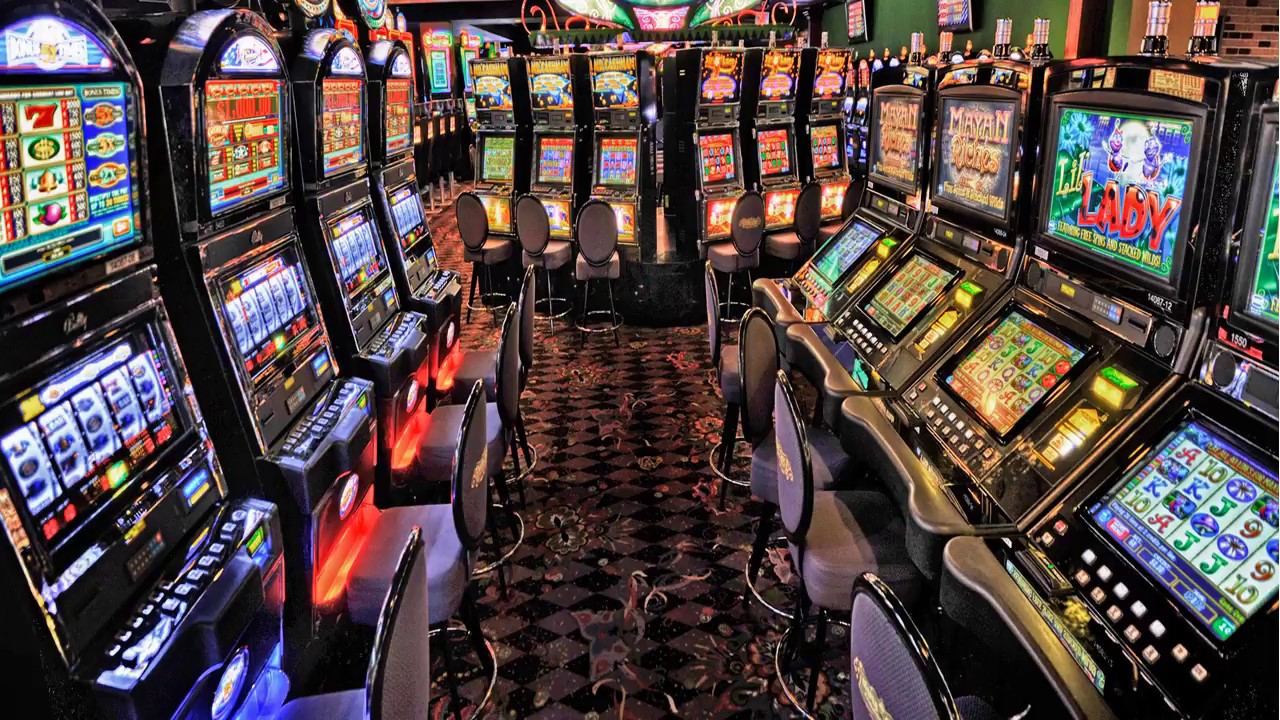
Casinos used to hold slot machine players’ attention through the gambling aspect alone. Players were perfectly fine with classic slot machines, which have bland themes and no special features.
But the gaming world has changed greatly over the past few decades. Slot machines are a perfect example of this because they now offer detailed themes and sophisticated features.
No longer can casinos put single-line slots on their floor and expect players to flock to them. Instead, they need games that offer a variety of aspects that can draw players.
Note:Some of these aspects include psychological factors that casinos and slots makers use to keep you spinning the reels. This may sound sinister, but casinos are like any other business in that they earn more money when customers stick around longer.
I don’t personally have a problem with this. But I also like to be aware of the different psychology tricks that casinos use to keep people playing more.
Today, I’m going to discuss with you how casinos employ psychology to win your bankroll – without you even realizing it!
Holding Attention with an Immersive Slots Experience
Most slots players have a vague idea that slot machine themes and sounds are used to draw them in. But many of these same players don’t realize the degree to which casinos use these aspects.
A study appearing in the journal Psychology of Addictive Behaviors tested a theory called the “slot machine zone,” where players ignore their surroundings while playing slots.
Researchers from the University of British Columbia (UBC) measured how the fast, entertaining nature of slot machines causes players to ignore the outside world.
They recruited two groups of people, including a group of experienced slot machine players and a group of UBC undergrads. Both sides participated in a 30-minute slot machine session at the UBC lab.
The slots featured panels on each side that showed moving white circles. Players were asked to push a button whenever they saw a white circle turn into a red square.
Following the session, each player described whether they entered a trance-like state while playing slots.
Important:The UBC team discovered that players who are at a higher risk of problem gambling are more immersed during slot sessions. Furthermore, these players missed shapes changing on the side panels more often than non-problem players.
Luke Clark, the director for UBC’s Centre for Gambling Research, said the results show that slot machines can immerse problem gamblers into the game more. This same element may even keep responsible players on slot machines a little longer.
“This confirms there is indeed a link between gambling addiction and the so-called slot machine zone,” Clark told the University of British Columbia News.
“When the experienced slot machine gamblers played, we found they not only felt that they lost track of time and their surroundings, but they often failed to notice the shapes on the periphery of the machine.”
Clark added that his team would like to further explore the subject by studying which slots features cause immersion.
Playing Slots Free
“There is potential for slot machines to be designed in a way that promotes more responsible use by disrupting the slot machine zone state,” he explained.
“Since static signs and stickers on slot machines are unlikely to distract immersed players, the messages should be eye-catching and as close as possible to the slots reels.”
More Paylines Lead to Losses Disguised as Wins
Older slot machines feature a win-or-lose model. You insert your money, push the button, and you either win or lose – there’s no in between.
Modern slot machines now blur the lines between wins and losses thanks to multiple paylines. Some slot machines feature up to 300 lines, giving you numerous chances to win on any turn.
But this also creates an addictive effect called losses disguised as wins (LDWs), where you only earn back a portion of your original bet.
Here’s an example:
- I’m playing a 100-line slot machine
- I bet one cent on each line ($1 total)
- I win a $0.30 payout on one line
- My net loss is $0.70
Any player can logically see that this is a loss. But modern slot machines disguise this through flashing lights and triumphant sound effects.
Even the example above can make you feel like a winner when you’re playing slots at a rapid rate and don’t have time to calculate everything.
Natasha Dow Schüll, a cultural anthropologist and associate professor of media and communication at New York University, wrote a book on the addictive nature of slot machines. Addiction by Design: Machine Gambling in Las Vegas dedicates multiple pages to LDWs.
Schüll also spoke with Vox through a 2014 feature on how computerization makes LDWs and other addictive slots traits possible.
“The computerization of slot machines gave casinos such precise control over odds that they could offer much higher jackpots and more exciting games while really controlling percentage payback and the odds,” said Schüll.
“The laboratory research on this shows that people experience this in their brains in an identical way as a win.”
The laboratory research that she refers to is a 2011 study from the University of Waterloo in Ontario. The team sought to learn if LDWs, including winning sounds and graphics, gave players the same “arousal” as regular wins.
They measured skin conductance response (SCR) amplitudes and heart-rate changes after regular wins, LDWs, and losses on 40 slot machine players.
They found that both wins and LDWs produce similar SCR. Meanwhile, LDWs offer a significantly higher arousal rate than total losses.
University of Waterloo researchers concluded that reinforcing sights and sounds produce arousal during LDWs that’s similar to a real win. This is despite the fact that players indeed lose money with LDWs.
Even the Slot Machine Is Designed to Encourage More Play
The onscreen action and sound effects aren’t the only things that players should watch out for regarding slot machines’ addictive nature. The cabinets themselves are also designed to keep players on machines.
Here are examples of slot cabinet features that are meant to encourage more play:
- Bill/ticket acceptors that can be reached with little effort involved
- Game buttons that are easily accessible
- Ergonomic seats that allow players to sit comfortably for hours
- Popular slot machines in alcoves or crannies, because many players like privacy
The casino itself also has various aspects that encourage more slots betting.
They have convenient ATMs located throughout gambling establishments that allow players to quickly withdraw money. Casino hosts may even approach a losing player afterward and offer them a free breakfast or dinner.
This is a delicate matter, because casinos can’t legally change odds while people are playing. But Schüll explains that they may be able to reduce volatility mid-play, so long as it doesn’t change the payback percentage.
Adding Skill to the Equation
Casinos began rolling out skill-based slot machines in the mid-2010s. The idea is to appeal to millennials, who don’t play traditional slot machines as much as previous generations.
Game makers and casinos hope that introducing skill into the equation will remedy this.
These games are played like normal slot machines, where you spin the reels and receive random results. But the second-screen bonus rounds offer skill-based play.
Here are a few examples:
- Space Invaders has a bonus round where you move a plane around to shoot advancing aliens
- Centipede’s bonus round has you shoot at giant centipedes as they come down the screen
- Race Ace sees you race against competitors to win a larger prize
These slot machines combine traditional addictive slots qualities with a skill-based side game. Casinos hope that this addition keeps players spinning the reels and trying to trigger the bonus.
Psychology Of Playing Slot Machines At Casino
Game makers have even been producing arcade-style gaming that cuts out the slot machine aspect. One example is Danger Arena, a first-person shooter that involves blasting robots for a higher score.
Recommended Reading:Some players may be under the false assumption that they can win long-term profits with skill-based slots and arcade games. But the important thing to understand is that the skill-based variable only affects a certain percentage of payback.
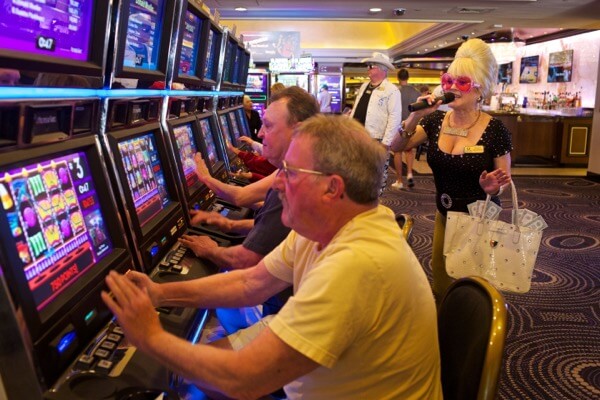
The house still has the edge with these games. But a skilled player can at least improve their odds of winning money.
It remains to be seen whether skill-based casino games will take off. After all, they’re still relatively new in comparison to traditional slot machines.
But what’s clear is that these games introduce yet another psychological element that can keep people playing.
Conclusion
Casinos don’t just rely on regular slot games drawing players. Instead, these machines also incorporate psychology to keep people spinning.
You might think that this makes casinos evil. But it’s no different from the business model used by Dave & Buster’s and Chuck E. Cheese.
Companies also design their facilities and place games in a specific manner that maximizes play. The only difference with slot machines is that you stand to lose more money when falling into a trance.
More recent developments include skill being incorporated into bonus rounds. While it’s nice to control your results, remember that you’re still facing a long-term disadvantage.
I’m fully aware of the psychology used in slot machines. But I still like playing these games for entertainment.
I use my better judgment to avoid being hypnotized and playing more than my bankroll allows for. The key is to set a time or loss limit and stick with it.
Playing Slot Machines In Vegas
It also helps to constantly remind yourself that LDWs aren’t real wins and there’s an entire world happening around you away from the machine. As long as you don’t lose yourself in slot machines, then you won’t lose much money either.